
Introduction
You plug in your MacBook, and nothing happens. Maybe it boots to a black screen, or the keyboard and trackpad both die at the same moment. Either way, a technician gives you the verdict: "It's the logic board."
Suddenly you're staring at a repair quote that rivals the price of a new laptop — and wondering whether to pay up, replace the device, or walk away.
Logic board repair cost varies dramatically — from $200 for targeted component fixes to well over $1,000 for a full board replacement. The difference comes down to what kind of repair you're quoted and who's doing the work. This guide breaks down what drives those costs and how to decide whether repair actually makes sense for your situation.
TLDR
- MacBook logic board repair typically costs $200–$600 depending on repair type, model, and shop
- Micro-soldering individual components costs far less than replacing the entire board
- M1/M2 MacBooks cost more to repair due to chip complexity and integrated architecture
- Repair makes sense when the cost stays under 50% of the MacBook's resale value
- An independent shop quote can save hundreds compared to Apple's pricing
How Much Does MacBook Logic Board Repair Cost?
"Logic board repair" covers two very different services. A full logic board replacement swaps out the entire motherboard assembly. A component-level repair diagnoses and fixes the specific failing chip or circuit on your existing board using micro-soldering techniques.
The cost difference is dramatic: a $300 targeted repair might fix the exact same issue Apple quoted $1,000+ to replace.
Here's how those tiers break down — and what you actually get at each price point.
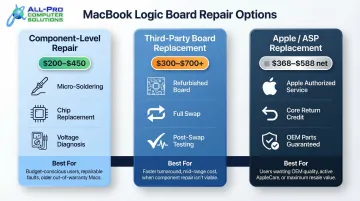
Tier 1: Component-Level Repair (Micro-Soldering)
Typical cost range: $200–$450
Component-level repair targets single-point failures—a dead Power IC, faulty Charging IC, corrupted WiFi module, or liquid damage affecting specific circuits. The technician uses microscopes and soldering equipment to replace individual chips and repair damaged traces on your existing logic board.
What's included:
- In-depth diagnosis using voltage injection and thermal imaging
- Targeted chip or circuit replacement
- No board swap—your original board is repaired
- Best for: Charging issues, power failures, single-component failures, some liquid damage
Tier 2: Full Logic Board Replacement (Third-Party Shop)
Typical cost range: $300–$700+
When the damage is too widespread for micro-soldering—multiple failed components, severe liquid corrosion, or catastrophic physical damage—a full board replacement becomes necessary. Third-party shops source replacement boards (often refurbished or pulled from donor units) and swap out the damaged board entirely.
What's included:
- Sourced replacement logic board (refurbished or donor unit)
- Full installation and testing
- Best for: Boards with widespread damage that can't be micro-soldered
Cost by generation:
- Older Intel models (pre-2020): $300–$500
- M1/M2 models (2020+): $500–$700+
Tier 3: Apple or Authorized Service Provider Replacement
Typical cost: Net $368–$588 (after core return credit)
According to Apple's Self Service Repair pricing, logic boards are listed at retail prices from $526 to $4,222+, but customers receive a large core return credit when they send back the broken board, reducing net cost to $368–$588 depending on model.
Critical limitation: Apple does not offer component-level repair. Every logic board issue results in a full board replacement quote—which is why Apple's prices are often far higher than independent shops that can perform targeted repairs.
What Drives the Cost of MacBook Logic Board Repair?
The final repair quote is shaped by several technical and logistical factors. Understanding them helps you evaluate whether any estimate you receive is fair.
MacBook Model and Chip Generation
Older Intel-based MacBooks (pre-2020) are generally less expensive to repair because their logic boards feature more discrete, replaceable components. RAM modules, storage drives, and even some power management chips can be swapped individually.
M1 and M2 models are a different story. Apple's System on a Chip (SoC) design integrates the CPU, GPU, RAM, and storage controller directly onto a single chip. This Unified Memory Architecture means a single $5 power IC failure can render the entire board inoperable, and component-level repair requires far more skill and specialized equipment.
Type and Extent of Damage
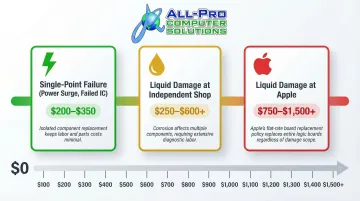
A single-point failure—say, a Power IC that died from a power surge—is straightforward to diagnose and fix. The technician isolates the failing component, removes it with precision micro-soldering tools, and replaces it. Cost: typically $200–$350.
Liquid damage is far more involved. Spilled coffee doesn't just short out one chip — it triggers electrochemical corrosion that spreads across multiple voltage rails, bridges circuit pads, and corrupts traces under Ball Grid Array (BGA) chips. Independent repair labs use ultrasonic cleaning to remove corrosion from beneath chips, followed by microscopic diagnosis to pinpoint damaged components.
That complexity explains the wide price swings:
- Single-point failures (power surge, failed IC): $200–$350
- Liquid damage at independent shops: $250–$600+
- Liquid damage at Apple: $750–$1,500+ (Apple classifies all liquid damage as Tier 4 "catastrophic," triggering full board replacement)
Parts Availability and Sourcing
For older models (pre-2015), original Apple components may be scarce. Shops sometimes source salvaged parts from donor boards or use third-party equivalent components that meet original specifications.
For M1/M2 models, the challenge flips. Apple's proprietary design means fewer compatible aftermarket parts exist, and the SoC is serialized and paired to other components. Replacing a board also requires Apple's proprietary Repair Assistant software to calibrate the Touch ID sensor — skip that step, and biometric login stops working. That limited parts ecosystem pushes costs up from a different direction.
Where You Take It: Apple vs. Independent Repair Shop
Apple performs board replacements only, not repairs. Every logic board issue triggers a full board swap at premium pricing. Independent shops—especially those with micro-soldering capabilities—diagnose at the component level and repair what's actually broken.
In the North Bay Area, shops like APCS offer component-level diagnosis and repair, which can cost significantly less than Apple's board replacement quotes. However, shop quality varies widely. Look for technicians with specific experience in board-level Mac repair, not just general computer service.
Signs of MacBook Logic Board Failure
Logic board symptoms overlap heavily with other hardware issues, which is why proper diagnosis—not just visual inspection—is essential before assuming board failure.
Primary Symptoms Indicating Logic Board Involvement
- Keyboard and trackpad fail simultaneously — not two separate hardware failures, but a central logic board controller issue
- Zero response when pressing power: no lights, no current draw, no fan spin — often points to failed power management chips or shorted voltage rails
- System boots (fans spin, startup chime sounds) but the screen stays black or shows distorted artifacts, indicating a failed display controller IC or backlight driver on the board
Power and Charging Anomalies
- No light on MagSafe connector: The charger shows no green or amber indicator, suggesting the charging circuit on the logic board isn't communicating with the power adapter
- Battery not charging despite healthy battery: macOS reports the battery as functioning, but the charge percentage never increases—a classic charging IC failure
- Unexpected random shutdowns on full charge: The MacBook powers off without warning even though the battery shows 50%+ charge, indicating power management IC instability
Important: Many of these symptoms also occur with simpler issues. A MacBook Air might fail to power on due to liquid corrosion on the trackpad cable, which forces the system into a protective low-power state that mimics a dead logic board. Display malfunctions may stem from a faulty display assembly rather than the logic board. A qualified technician using voltage injection and thermal imaging can confirm the root cause.
Repair vs. Replace: Is It Worth It?
The 50% Rule and Current Resale Values
Consumer Reports recommends replacing a broken item if the repair costs more than 50% of the price of a new or equivalent replacement product.
Let's apply this to real-world MacBook values:
- 2020 M1 MacBook Air: Currently averages $468 on Swappa. Under the 50% rule, repairs over $234 are economically questionable.
- 2022 M2 MacBook Air: Averages $515–$672 on Swappa. 50% threshold is $257–$336.
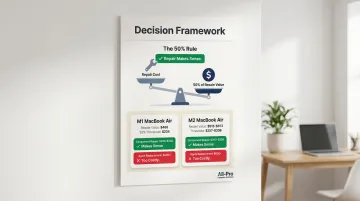
Apple's full board replacement quotes ($600+) fail this test for older models. Independent component-level repairs ($200–$350) keep the device economically viable.
Age-and-Use Calculation
MacBook under 3 years old: Almost always worth repairing. Even a $400 fix on a machine worth $1,200 is a clear win. You keep your familiar setup, avoid data migration hassles, and extend the device's productive life by 3–5 years.
MacBook 3–5 years old: Still worth repairing if it handles your workload well. Factor in hidden replacement costs: new software licenses, productivity lost during transition, and hours spent migrating years of data.
MacBook 6+ years old: Needs more scrutiny. If you're doing basic web browsing and email, a $250 repair might buy another 2 years of service. If you need modern performance for video editing or development, replacement may be the smarter long-term investment.
The Data Recovery Factor
Logic board failure puts stored data at risk—especially on M1/M2 MacBooks, where storage is soldered directly to the board and encrypted by the Secure Enclave. Replacing the board permanently destroys access to the original data.
Repairing the board may be the only way to recover files without costly separate data recovery services, which run $200–$1,500 at independent labs or $2,400–$4,900+ at corporate recovery services.
Factor this into your total cost-of-replacement calculation. A $400 logic board repair that also recovers your data may be far cheaper than a $300 replacement plus $800 data recovery.
The "Component Repair First" Strategy
Before accepting a full board replacement quote, seek a second opinion from a shop capable of micro-soldering. In many cases, a $250 targeted repair on a failing Power IC resolves the same issue a $900 board swap was quoted for.
For North Bay Area MacBook owners, APCS provides honest diagnostics and transparent repair options. With over 25 years of experience in Mac repair, the team can walk you through whether targeted component repair, full board replacement, or a new device makes the most sense for your situation.
What Most People Get Wrong
Most people fixate on the repair quote and overlook the full cost of replacement:
- Data migration fees and time lost setting up a new machine
- Repurchasing software licenses (Adobe Creative Cloud, Microsoft Office, specialized business apps)
- Productivity lost during the transition
- A new MacBook runs $1,000–$2,500—often far more than an expensive repair
It's also worth knowing that Apple doesn't offer component-level repair. Every logic board issue results in a board replacement quote. An independent technician may diagnose the same problem as a $300 chip fix that Apple quoted at $700+.
Conclusion
MacBook logic board repair costs range widely—from $200 for a targeted micro-solder fix to $600+ for a full board swap—and whether it's worth it depends on your device's age, current value, type of damage, and what replacement would actually cost when you factor in data migration, software repurchasing, and lost productivity.
Start with a professional, honest diagnosis. Not all logic board failures require full replacement, and the right shop will tell you which option actually makes sense for your situation—not just the one that costs more.
For MacBook owners in the North Bay Area, APCS has been doing exactly that since 1998. With two locations serving Sonoma and Marin counties, the team provides straightforward repair-or-replace guidance backed by over 25 years of hands-on experience. Call (707) 400-7100 (Sonoma County) or (415) 900-8928 (Marin County) to talk through your MacBook repair options.
Frequently Asked Questions
How much does it cost to get the logic board replaced on a MacBook?
Full logic board replacement costs approximately $300–$700+ at independent shops, or $368–$588 at Apple (after core return credit, varies by model). Component-level micro-soldering repair typically runs $200–$450 for targeted fixes — often the more cost-effective route.
Is it worth repairing a 3 year old MacBook?
Yes, a 3-year-old MacBook is generally well worth repairing. It still has several productive years ahead, its resale value is meaningful, and a logic board repair at $200–$500 is a fraction of a $1,200–$2,000 replacement cost.
What are signs of logic board failure?
Key warning signs include complete failure to power on, simultaneous input failures (keyboard and trackpad both unresponsive), random shutdowns, blank or distorted display, and no response from the charger indicator light. A technician should test components individually before concluding the board is at fault, since these symptoms can also point to a failed battery, damaged flex cable, or other hardware issues.
What is the lifespan of a logic board?
A logic board in a well-maintained MacBook can last 7–10 years or more. However, liquid exposure, overheating, and power surges can shorten that lifespan considerably, according to Macworld. Catching early warning signs quickly usually means a cheaper, more targeted repair.
Can a MacBook logic board be repaired instead of fully replaced?
Yes, component-level micro-soldering repair is a legitimate and often significantly cheaper alternative to full board replacement, depending on the nature of the fault. Not all shops offer this service—seek out technicians with board-level repair experience.
Does Apple offer logic board repair, or only replacement?
Apple and Apple Authorized Service Providers perform board-level replacement only—they do not offer micro-soldering or component repair. This is why independent shops can often provide the same functional outcome at a lower cost through targeted component-level repairs.